Meaning & Symbolism
Lotus Flower Meaning: Symbolism, Colors & Spiritual Significance
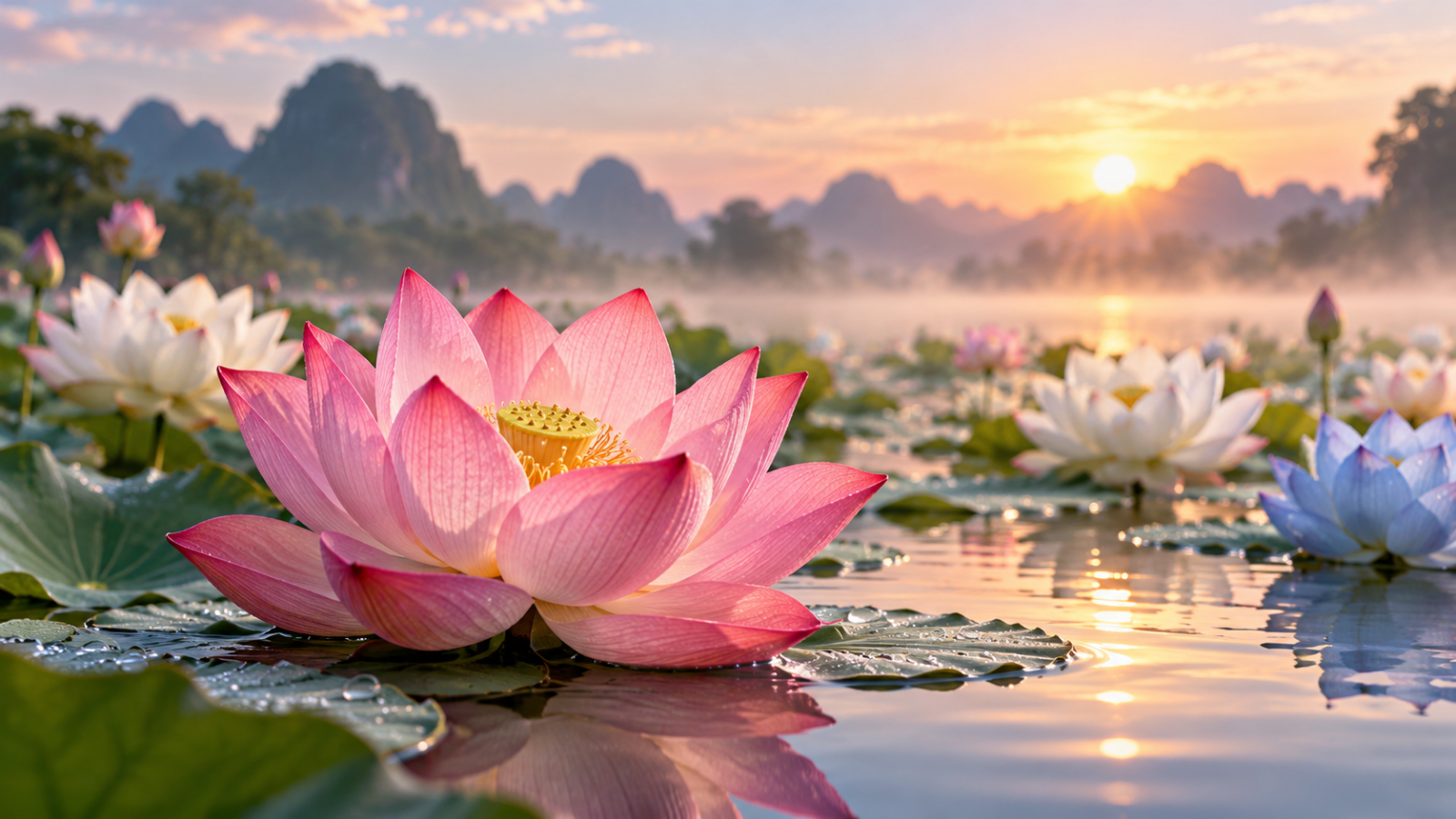
The lotus flower meaning is most closely associated with purity, spiritual awakening, rebirth, resilience, and transformation. Much of its symbolism comes from the remarkable way the plant grows: its roots are anchored in mud, yet its stem rises through the water and produces an elegant flower above the surface.
That journey from mud to bloom has made the lotus a powerful symbol of overcoming difficulty without being defined by it.
For thousands of years, lotus imagery has appeared in religious traditions, sacred art, architecture and cultural symbolism. It is especially important in Buddhism and Hinduism, where the flower is connected with spiritual development, purity and enlightenment. Kew Gardens notes that the sacred lotus, Nelumbo nucifera, has deep religious importance in both traditions.
The exact meaning of a lotus flower can also change according to its colour and cultural context.
What Does a Lotus Flower Mean?
At its simplest, the lotus symbolizes the possibility of rising above difficult circumstances and becoming something beautiful despite them.
Its most common meanings include:
Purity
Spiritual enlightenment
Rebirth
Renewal
Resilience
Transformation
Inner peace
Wisdom
Divine beauty
Personal growth
The symbolism makes sense when you look at the plant itself.
A lotus grows from rhizomes anchored in the muddy bottom of ponds, lakes and wetlands. Its stems rise through the water before its leaves and flowers appear above the surface.
As a metaphor, the mud can represent struggle, suffering or imperfection, while the flower above the water represents growth, clarity and awakening.
This is why the lotus is frequently used to express a simple idea:
Your beginnings and difficulties do not have to determine what you become.
Lotus Flower Spiritual Meaning
The spiritual meaning of the lotus flower centres on awakening and transformation.
Because the flower emerges from muddy water yet appears clean and beautiful above it, it has become a natural symbol of spiritual development.
In this interpretation:
Mud represents hardship, confusion or worldly difficulties.
Water represents the journey through those challenges.
The rising stem represents growth and perseverance.
The open flower represents awareness, enlightenment and spiritual fulfilment.
The lotus therefore does not symbolize avoiding hardship. Instead, it represents developing through it.
That distinction is one reason the lotus remains meaningful to people who may not follow a specific religion. It can represent recovery, emotional growth, personal transformation or beginning again after a difficult period.
Why Does the Lotus Flower Symbolize Purity?
Purity is one of the oldest meanings associated with the lotus.
Although the plant grows from muddy conditions, its flower rises above the water.
This contrast between the environment below and the bloom above created a powerful spiritual metaphor: something pure can emerge from an imperfect world.
The Metropolitan Museum of Art describes the lotus in Indian religious symbolism as an image of spiritual perfection—the flower rises from muddy water unstained, just as a devotee seeks to move beyond the imperfect world toward enlightenment.
For this reason, lotus symbolism often connects purity not simply with innocence, but with maintaining clarity and integrity despite difficult surroundings.
Lotus Flower Meaning: Rebirth and New Beginnings
The lotus is also strongly associated with rebirth, renewal and new beginnings.
A flower emerging above dark, muddy water naturally creates an image of something new appearing after difficulty.
The idea becomes even stronger in traditions where the opening and closing of aquatic flowers was connected with cycles of darkness and light.
Today, people may use lotus imagery to represent:
beginning a new chapter
emotional recovery
leaving a difficult period behind
personal reinvention
spiritual growth
healing
starting again
This makes the lotus especially meaningful during periods of major life change.
Does the Lotus Flower Mean Strength?
Yes, although resilience is often a more precise description than physical strength.
The lotus does not overcome its environment by escaping it.
It grows through it.
Its symbolism therefore represents the ability to experience difficulty while continuing to develop.
A lotus can consequently represent:
Strength through adversity: continuing despite challenging circumstances.
Emotional resilience: recovering after setbacks.
Patience: growth happening gradually rather than immediately.
Inner strength: remaining grounded while circumstances change.
Transformation: becoming stronger or wiser because of experience.
For someone choosing a lotus as a personal symbol, this interpretation can be especially powerful.
Lotus Flower Meaning by ColorColour can add another layer of meaning to lotus imagery.
However, colour symbolism should be treated carefully. Not every modern colour interpretation comes from an ancient religious tradition, and meanings can vary across cultures and artistic contexts.
The most historically significant lotus colours include white, pink, blue and red, while purple, yellow, gold and black often receive broader or more contemporary interpretations.
White Lotus Flower Meaning
The white lotus meaning is strongly connected with:
purity
spiritual clarity
peace
enlightenment
purity of mind and spirit
White naturally reinforces the lotus's wider association with cleanliness and spiritual development.
In Buddhist symbolism, white lotus imagery is commonly associated with spiritual purity.
A white lotus is therefore an appropriate symbol for someone wanting to express inner peace, clarity or spiritual growth.
Pink Lotus Flower Meaning
The pink lotus flower meaning is particularly significant within Buddhist imagery.
Pink lotus symbolism is commonly associated with:
the Buddha
spiritual awakening
devotion
sacredness
enlightenment
Floraly's own competitor article identifies the pink lotus with Buddha, while contemporary lotus guides continue to highlight pink as one of the most spiritually important lotus colours.
Because of this connection, pink lotus imagery often carries a more explicitly sacred tone than a general decorative lotus.
Blue Lotus Flower Meaning
The blue lotus meaning is commonly connected with:
wisdom
knowledge
intelligence
spiritual awareness
mastery of the senses
There is an important botanical distinction here.
Some flowers historically called blue lotus, particularly in discussions of ancient Egypt, are actually water lilies rather than true members of the lotus genus Nelumbo.
This distinction matters when discussing historical symbolism.
Red Lotus Flower Meaning
A red lotus is generally associated with the heart and emotional life.
Common meanings include:
love
compassion
passion
empathy
emotional openness
Compared with the reflective symbolism of blue or the purity associated with white, red gives lotus imagery a warmer, more emotional meaning.
Purple Lotus Flower Meaning
Purple lotus symbolism is often associated with:
spirituality
mystery
contemplation
self-discovery
spiritual development
Purple frequently appears in modern spiritual interpretations of the lotus.
When religious accuracy matters, however, it is better not to assume that every modern colour association represents one universal ancient tradition.
Yellow or Golden Lotus Meaning
Yellow and gold lotus imagery is often interpreted as representing:
enlightenment
wisdom
prosperity
achievement
spiritual fulfilment
Gold naturally carries associations with value, illumination and attainment, which makes it visually compatible with the lotus's broader symbolism of awakening.
Black Lotus Meaning
A naturally black lotus is not part of the traditional sacred-lotus colour system most people encounter in Buddhist or Hindu imagery.
In modern art, fashion and tattoo symbolism, however, a black lotus may represent:
mystery
individuality
transformation
strength
overcoming darkness
independence
These are largely contemporary interpretations rather than one fixed traditional religious meaning.
Lotus Flower Color Meanings at a Glance
| Lotus Colour | Common Meaning |
|---|---|
| White | Purity, peace, spiritual clarity |
| Pink | Buddha, devotion, spiritual awakening |
| Blue | Wisdom, knowledge, awareness |
| Red | Love, compassion, emotional openness |
| Purple | Spirituality, mystery, contemplation |
| Yellow/Gold | Enlightenment, achievement, prosperity |
| Black | Modern symbol of strength, individuality and mystery |
The surrounding cultural or artistic context should always be considered before assigning one definitive meaning to a lotus colour.
Lotus Flower Meaning in BuddhismThe lotus flower meaning in Buddhism is closely associated with enlightenment, spiritual purity and rising above suffering.
The visual metaphor is particularly powerful.
A lotus begins in mud but rises upward and blooms above the water. Similarly, Buddhist spiritual development involves moving beyond ignorance, attachment and suffering toward greater understanding.
The Metropolitan Museum of Art describes the lotus as an auspicious Buddhist symbol connected to the Buddha's enlightenment, and historic Buddhist art frequently places Buddhas and bodhisattvas on lotus pedestals.
This is why lotus imagery appears so frequently in:
Buddhist statues
temple decoration
sacred paintings
meditation imagery
religious architecture
lotus thrones or pedestals
Rather than being merely decorative, the flower can serve as a visual representation of the spiritual path.
Why Is Buddha Shown With a Lotus?
Lotus imagery surrounding Buddha visually reinforces ideas of enlightenment and spiritual perfection.
In Buddhist art, sacred figures may sit or stand on stylized lotus flowers or lotus-shaped pedestals.
The image expresses the same metaphor as the living flower: spiritual realization can emerge from ordinary worldly existence without being corrupted by it.
Lotus Flower Meaning in HinduismThe lotus flower meaning in Hinduism is similarly profound.
The sacred lotus is associated with:
purity
divinity
fertility
beauty
prosperity
spiritual liberation
creation
Kew notes that the sacred lotus has deep religious meaning in Hinduism and is associated with divinity, purity and fertility.
Lotus imagery is also connected with important Hindu deities.
Lotus and Lakshmi
Lakshmi, the Hindu goddess associated with prosperity and abundance, is frequently depicted with lotus imagery.
This association strengthens the flower's connection with:
prosperity
beauty
abundance
divine blessing
fertility
As a result, lotus imagery can symbolize both spiritual and material flourishing.
Lotus and Vishnu
Vishnu is also frequently represented in Hindu iconography with lotus symbolism.
Within this broader religious context, the lotus can express cosmic order, divinity and spiritual purity.
Lotus and Spiritual Awakening
The lotus also works as a metaphor for inner spiritual development.
A person can remain rooted in everyday physical existence while directing consciousness toward greater spiritual awareness—just as the plant remains rooted in mud while its flower rises toward the light.
Lotus Meaning in Ancient EgyptThe phrase Egyptian lotus requires an important clarification.
Many plants called “lotus” in discussions of ancient Egypt were actually water lilies, particularly blue and white Nymphaea species, rather than true lotuses of the genus Nelumbo.
Floraly correctly makes this botanical distinction in its article.
The symbolism, however, was extremely important.
The Metropolitan Museum of Art explains that the aquatic flower closed at night and reopened in the morning. Ancient Egyptians associated this pattern with the rising sun, creation, rejuvenation and daily rebirth.
Egyptian “lotus” imagery therefore became associated with:
rebirth
rejuvenation
creation
the sun
renewal
life after darkness
This symbolism appeared widely in ancient Egyptian art and decorative objects.
Why Is the Lotus Considered Sacred?The lotus became sacred because both its physical growth and its visual beauty provided unusually powerful religious metaphors.
Its roots remain buried in mud.
Its stem rises through the water.
Its flower emerges above the surface.
That natural progression can be interpreted as a journey from:
darkness → struggle → growth → awakening
or:
impurity → purification → enlightenment
For religions concerned with spiritual transformation, this made the lotus an exceptionally effective symbol.
What Is a Sacred Lotus?The plant commonly called the sacred lotus is Nelumbo nucifera.
It belongs to the family Nelumbonaceae and is an aquatic perennial.
Kew recognizes Nelumbo nucifera as an accepted species and notes its long religious, cultural, culinary and ornamental history across Asia.
The genus Nelumbo contains only two accepted living species:
Nelumbo nucifera — sacred or Asian lotus
Nelumbo lutea — American lotus
Nelumbo nucifera is the species most strongly associated with Hindu and Buddhist symbolism.
Lotus vs. Water Lily: Are They the Same?No.
Although lotuses and water lilies can look similar, they belong to different botanical families.
Lotus: Nelumbonaceae
Water lily: Nymphaeaceae
True lotus flowers usually rise clearly above the water on strong stems, while many water-lily flowers sit on or close to the water's surface.
Kew confirms that sacred lotus is distantly related to water lilies despite their superficial similarity.
This distinction is especially useful when researching the “blue lotus” of ancient Egyptian history, because those famous flowers were actually water lilies.
What Is the Lotus Effect?The lotus is remarkable not only symbolically but scientifically.
Lotus leaves have an extraordinary ability to repel water.
Water forms droplets on the surface rather than spreading evenly. As those droplets roll away, they can carry dirt particles with them.
This self-cleaning behaviour inspired the scientific term “lotus effect.”
Interestingly, the biological feature reinforces the flower's traditional symbolism: a plant associated with purity also possesses leaves that resist wetting and contamination.
Why Is the Lotus Associated With Resilience?The lotus has become an especially popular symbol of resilience because its beauty does not depend on perfect growing conditions.
Its roots exist in mud and sediment.
Yet the flower rises above that environment.
That makes the lotus an intuitive metaphor for someone who has experienced:
hardship
grief
recovery
personal change
emotional challenges
major life transitions
The message is not that difficulty disappears.
The message is that growth remains possible within it.
Does a Lotus Flower Symbolize Love?It can.
The lotus is not primarily a romantic flower in the same way a red rose is, but some interpretations—particularly those associated with red lotus imagery—connect it with:
love
compassion
empathy
emotional openness
devotion
A lotus can therefore represent a deeper or more spiritual form of love rather than purely romantic attraction.
Does a Lotus Mean New Beginnings?Yes.
Because the lotus represents renewal and emergence from difficult conditions, it has become a natural symbol of new beginnings.
Someone may choose lotus imagery after:
beginning a new phase of life
recovering from hardship
ending an unhealthy situation
experiencing personal growth
beginning a spiritual journey
making an important life change
In this context, the lotus represents not forgetting the past, but growing beyond it.
What Does a Lotus Flower Tattoo Mean?A lotus flower tattoo commonly represents:
personal growth
resilience
spiritual awakening
healing
rebirth
purity
transformation
Its exact meaning depends on the person wearing it.
Colour can also modify the interpretation. A white lotus tattoo may suggest purity or peace, while blue may emphasize wisdom and red may emphasize love or compassion.
Because lotus symbolism originates in living religious traditions, someone using explicitly Buddhist or Hindu sacred imagery may also want to understand the original cultural context rather than treating it only as decoration.
What Does Giving Someone a Lotus Mean?Giving lotus flowers or lotus-inspired imagery can communicate a thoughtful message.
Depending on context, it may say:
“You have overcome a difficult time.”
“I wish you peace.”
“This is a new beginning.”
“Your growth inspires me.”
“Stay strong through change.”
For that reason, lotus symbolism can suit gifts connected with healing, recovery, personal milestones and new chapters.
Frequently Asked Questions About Lotus Flower MeaningWhat is the main meaning of a lotus flower?
The lotus flower most commonly symbolizes purity, enlightenment, rebirth, resilience and transformation. Its symbolism comes largely from the way it grows from muddy conditions yet produces a striking bloom above the water.
What does a lotus mean spiritually?
Spiritually, the lotus represents awakening, personal transformation and rising above suffering or negative circumstances.
Why does a lotus symbolize rebirth?
Its emergence from mud and water into an open flower makes it a natural metaphor for renewal and transformation. Similar aquatic-flower symbolism in ancient Egypt was also connected with daily rebirth and the rising sun.
What does a white lotus symbolize?
A white lotus generally represents purity, spiritual clarity, peace and enlightenment.
What does a pink lotus symbolize?
Pink lotus imagery is strongly associated with Buddha and spiritual awakening in Buddhist contexts.
What does a blue lotus mean?
Blue lotus imagery is commonly connected with wisdom, knowledge and spiritual awareness, although the famous ancient Egyptian “blue lotus” is botanically a water lily.
What does a red lotus mean?
Red lotus symbolism commonly centres on compassion, love, passion and matters of the heart.
Does lotus symbolize strength?
Yes. More specifically, the lotus is a strong symbol of resilience—the ability to grow through difficult conditions rather than being defined by them.
Does a lotus symbolize healing?
Modern interpretations frequently use lotus imagery to symbolize healing, recovery and personal transformation.
What does the lotus represent in Buddhism?
In Buddhist contexts, the lotus is closely associated with spiritual purity, enlightenment and rising above suffering. Historic Buddhist art frequently uses the lotus as an auspicious symbol connected with Buddha and enlightenment.
What does the lotus symbolize in Hinduism?
In Hindu traditions, lotus symbolism includes purity, divinity, fertility, beauty and prosperity. The flower is associated with important deities and has a long history in sacred imagery.
Are lotus flowers and water lilies the same?
No. True lotuses belong to the family Nelumbonaceae, while water lilies belong to Nymphaeaceae.
Final Thoughts: What Does the Lotus Flower Mean?The lotus flower meaning is powerful because it comes from the flower's own growth story.
It begins in mud, rises through water and eventually opens above the surface.
Across centuries, that journey has inspired meanings of purity, rebirth, resilience, spiritual awakening and transformation.
In Buddhism, lotus imagery is strongly linked with enlightenment and spiritual purity. In Hinduism, it is associated with divinity, fertility, beauty and prosperity. Ancient Egyptian aquatic-flower symbolism connected the so-called lotus—botanically a water lily—with the sun, renewal and rebirth.
Colour adds another layer: white represents purity, pink carries strong sacred associations, blue suggests wisdom, and red emphasizes love and compassion.
Yet the central message remains remarkably consistent.
The lotus reminds us that difficult surroundings do not make growth impossible. In fact, the mud beneath the flower is part of the story that makes its bloom meaningful.