Growing
How to Dry Flowers Quickly: 6 Easy Methods That Work
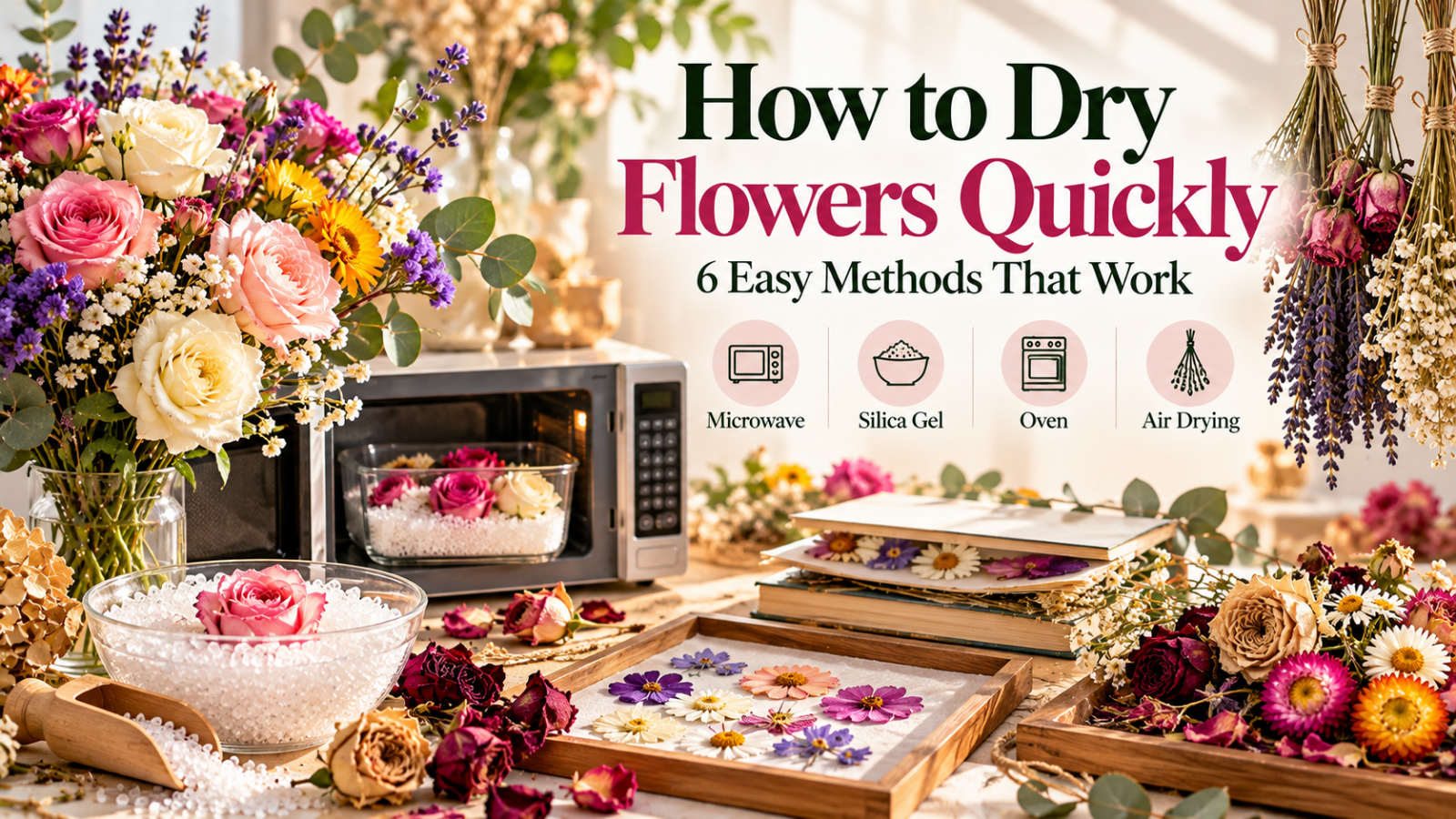
If you need to preserve flowers without waiting weeks, the fastest way to dry flowers is usually a microwave combined with silica gel. Depending on the flower and microwave, active heating may take only a few minutes, although the flowers should usually remain in the drying material afterward to finish cooling and drying.
For flowers where preserving their three-dimensional shape matters, silica gel is one of the best options. For flat craft projects, microwave pressing or traditional pressing works better. And if speed is not important, air drying remains the simplest method.
Here is the quick comparison:
| Drying Method | Approximate Time | Best For |
|---|---|---|
| Microwave + silica gel | Minutes + cooling time | Roses, daisies, dahlias, many full blooms |
| Silica gel without microwave | About 1–8 days | Preserving shape and color |
| Oven | A few hours | Petals, potpourri, craft flowers |
| Dehydrator | Several hours | Small flowers, petals, herbs |
| Microwave pressing | Minutes | Flat flowers for crafts |
| Air drying | 2–4 weeks | Bouquets, lavender, statice, baby's breath |
University of Missouri Extension describes microwave drying as taking only a few minutes, while silica gel alone typically dries suitable flowers in several days.
What Is the Fastest Way to Dry Flowers?
For most home projects, the fastest method is:
Microwave + silica gel
This method combines heat with a moisture-absorbing material that supports the petals while moisture leaves the flower.
It works particularly well when you want to preserve:
Rose heads
Dahlias
Daisies
Cosmos
Daffodils
Zinnias
Delphiniums
Small to medium flower heads
Missouri Extension reports microwave drying times ranging from roughly one minute for smaller or thinner flowers to around three minutes for dense flowers, though exact timing varies by microwave and flower type.
That makes it dramatically faster than air drying, which can take several weeks.
Method 1: How to Dry Flowers Quickly in the MicrowaveMicrowave drying is the fastest technique for many flowers.
However, the safest and most effective method is not simply placing bare flowers inside the microwave.
Flowers should normally be supported in a drying material such as silica gel.
What You Need
Fresh flowers
Microwave-safe container
Silica gel
Cup of water
Microwave
Small soft brush
Scissors
Step 1: Choose Flowers at the Right Stage
Use flowers that are:
Fresh
Undamaged
Free from disease
Dry on the outside
Not fully past their peak
Flowers that are already badly wilted will not regain their original shape during drying.
Clemson Extension recommends choosing flowers before they are fully open for microwave drying because fully opened flowers can lose petals more easily.
Step 2: Trim the Stems
Cut most of the stem away if you only need the flower head.
A short stem makes it easier to bury the bloom evenly in silica gel.
If you plan to use the flowers in an arrangement afterward, artificial floral wire can be attached later.
Step 3: Add Silica Gel
Pour approximately 1 inch of silica gel into the bottom of a microwave-safe container.
Place the flower upright on top.
Slowly pour additional silica gel around the petals.
Do not dump a large quantity directly onto delicate petals.
Instead, allow the granules to gradually support the flower's natural shape.
Continue until the flower is completely surrounded.
Step 4: Put a Cup of Water in the Microwave
Place a separate microwave-safe cup partly filled with water next to the flower container.
Both Floraly and Missouri Extension recommend this step to reduce the risk of excessive drying or scorching.
Step 5: Microwave in Short Intervals
Do not start with a long heating cycle.
Use short bursts and check the flower regularly.
A practical starting approach is:
Small delicate flower: short bursts
Medium flower: approximately 1–2 minutes total
Thick flower: may require closer to 2–3 minutes
Exact microwave power varies considerably.
The goal is to remove moisture without scorching the petals.
Step 6: Let the Flowers Rest
Do not immediately dig the flower out of hot silica gel.
Allow the container to cool.
Missouri Extension recommends leaving microwave-dried flowers in silica gel for approximately 12–24 hours after heating.
This allows drying to finish gradually.
Step 7: Remove the Silica Carefully
Once completely cool:
Gently pour away loose silica.
Lift the flower carefully.
Turn it upside down.
Tap gently.
Use a soft artist's brush to remove remaining granules.
The petals will be much more fragile than when fresh.
Method 2: How to Dry Flowers With Silica GelIf preserving the flower's shape and color matters more than absolute speed, silica gel without microwave heating is one of the best home methods.
Silica gel absorbs moisture while physically supporting the petals.
This makes it especially useful for flowers that would become distorted if simply hung upside down.
How Long Does Silica Gel Take?
Many common flowers require roughly 1–5 days, although thick flowers can take longer.
University of Missouri Extension gives examples including:
| Flower | Approximate Silica-Gel Drying Time |
|---|---|
| Daylily | 1 day |
| Yarrow | 1 day |
| Daisy | 2 days |
| Tulip | 2 days |
| Larkspur | 2 days |
| Rose | 2–3 days |
| Dahlia | 2–3 days |
| Daffodil | 2–3 days |
| Cosmos | 2–3 days |
| Iris | 2–3 days |
| Gladiolus | 2–3 days |
| Marigold | 3–4 days |
| Hyacinth | 4–5 days |
Times vary with flower size, thickness, humidity, and container conditions.
Step-by-Step Silica Gel Method
Step 1: Prepare an Airtight Container
Silica gel works best in an airtight container because otherwise it begins absorbing moisture from the surrounding air.
Step 2: Add a Base Layer
Pour about an inch of silica into the container.
Step 3: Position the Flower
Place the flower upright.
For flat flowers, you may place them face-up.
Step 4: Cover Carefully
Pour silica around the flower slowly.
Use a spoon if necessary.
Make sure the petals remain in their natural position.
Step 5: Cover the Flower Completely
Every petal should be surrounded by drying material.
Step 6: Seal the Container
Close the lid tightly.
Step 7: Check at the Recommended Time
Do not leave flowers indefinitely.
Over-dried petals can become excessively brittle.
Missouri Extension notes that removing flowers too soon can leave petals drooping, while excessive drying can make them brittle enough to break.
Why Is Silica Gel So Good for Drying Flowers?Silica gel has three major advantages.
It Dries Quickly
It removes moisture far faster than normal air drying.
It Supports the Petals
Flowers maintain more of their three-dimensional form.
It Often Preserves Color Better
Air-dried flowers can darken or fade dramatically.
Silica gel generally provides better color retention than slow hanging methods, although some color change should still be expected. Clemson and Missouri Extension both identify silica gel as one of the most useful all-around home flower-drying materials.
Method 3: How to Dry Flowers in the OvenOven drying is another relatively fast method.
It works best when perfect three-dimensional preservation is not essential.
It is especially useful for:
Potpourri
Petals
Craft materials
Flowers that will be broken apart later
Basic Oven Method
Preheat the oven to its lowest practical setting.
Place flowers on a baking tray.
Keep flowers separated.
Heat slowly.
Check frequently.
Remove them once they feel completely dry.
Avoid high temperatures.
The goal is dehydration, not baking.
Excessive heat can cause:
Browning
Scorching
Severe fading
Brittle petals
Because ovens vary substantially, check the flowers frequently rather than relying on one exact time.
Method 4: How to Dry Flowers in a Food DehydratorA food dehydrator provides more controlled airflow than a standard oven.
This makes it useful for:
Flower petals
Herbs
Small flower heads
Potpourri ingredients
Craft materials
How to Use a Dehydrator
Step 1
Remove unwanted stems and foliage.
Step 2
Arrange flowers in a single layer.
Do not pile them on top of one another.
Step 3
Use the lowest suitable temperature.
Step 4
Rotate trays periodically if your machine dries unevenly.
Step 5
Check flowers regularly.
The flowers are finished when the petals feel dry rather than cool and flexible.
Floraly recommends using low dehydrator temperatures and rotating trays periodically so the flowers receive more even airflow.
Method 5: How to Press Flowers Quickly in a MicrowaveIf you want flat flowers rather than a dried bouquet, microwave pressing is extremely fast.
This method works well for:
Greeting cards
Frames
Scrapbooks
Resin crafts
Bookmarks
Decoupage
Botanical artwork
Best Flowers for Pressing
Flat flowers generally work best.
Examples include:
Daisies
Pansies
Cosmos
Small asters
Violets
Individual petals
Floraly also recommends flat flowers such as daisies, pansies, and cosmos for pressing projects.
Quick Microwave Pressing Method
Place the flower between plain absorbent paper.
Add paper towel around it.
Place a flat microwave-safe plate or similar object on top.
Microwave for approximately 10–30 seconds.
Check the flower.
Repeat with short bursts if necessary.
Allow the flower to cool before handling.
Do not leave the microwave unattended.
Delicate flowers can scorch quickly.
Method 6: Air Drying FlowersAir drying is not fast, but it remains one of the easiest and most reliable methods.
It works especially well when your goal is a dried flower bouquet or posy.
Missouri Extension recommends air drying for flowers such as:
Baby's breath
Larkspur
Statice
Strawflower
Globe amaranth
Yarrow
How to Air Dry Flowers
Step 1: Remove Lower Leaves
Strip off unnecessary foliage.
Step 2: Divide Flowers Into Small Bundles
Avoid creating huge bunches.
Small bundles receive better airflow.
Step 3: Tie the Stems
Use:
String
Twine
Rubber bands
Step 4: Hang Them Upside Down
Choose a location that is:
Dark
Dry
Warm
Well ventilated
Step 5: Wait
Air drying generally requires approximately 2–4 weeks, although time varies with flower type and humidity. Floraly gives roughly 2–4 weeks in its broader guide, while extension sources similarly describe the process as taking several weeks.
Why Should Flowers Be Dried in the Dark?Sunlight fades flower pigments.
A dark location generally produces better color retention.
Clemson Extension specifically recommends warm, dry air in a dark location, noting that darkness helps preserve flower color.
This matters especially for:
Pink
Red
Purple
Blue
Even dried flowers displayed later should be kept away from strong direct sunlight if you want their color to last.
Which Flower-Drying Method Is Best?There is no single best technique for every flower.
Use this guide:
Best for Speed
Microwave + silica gel
Best for Keeping Natural Shape
Silica gel
Best for Preserving a Bouquet
Air drying
Best for Framed Flower Art
Pressing
Best for Potpourri
Oven or dehydrator
Best for Delicate Flat Flowers
Pressing
Best for Roses
Silica gel
Best for Baby's Breath
Air drying
Best Drying Method by Flower| Flower | Recommended Method |
|---|---|
| Rose | Silica gel or microwave + silica |
| Daisy | Pressing or silica gel |
| Dahlia | Silica gel |
| Daffodil | Silica gel |
| Tulip | Silica gel |
| Larkspur | Air drying or silica gel |
| Aster | Pressing or silica gel |
| Iris | Silica gel |
| Gladiolus | Silica gel |
| Cosmos | Pressing or silica gel |
| Baby's Breath | Air drying |
| Statice | Air drying |
| Lavender | Air drying |
| Hydrangea | Air drying or water drying |
For example, Missouri Extension estimates roses and dahlias at about 2–3 days in silica gel, daisies and tulips at about 2 days, and larkspur at about 2 days.
How to Dry Roses QuicklyRoses are ideal candidates for silica gel because their layered petals need support.
For roses:
Choose a flower that is fresh but not fully blown open.
Remove most of the stem.
Place it upright in silica gel.
Carefully cover between the petals.
Seal the container.
Check after roughly 2–3 days.
For even faster results, combine silica gel with careful microwave drying.
If you enjoy rose-related content, see our Rose Flower Meaning guide.
How to Dry DaisiesDaisies are versatile because they work well with both pressing and silica gel.
Use pressing if you want them for:
Frames
Cards
Scrapbooks
Resin crafts
Use silica gel when you want them to remain three-dimensional.
For more on the flower itself, explore our Daisy Flower Meaning guide.
How to Dry DahliasDahlias have thick, layered blooms, so hanging them can distort their shape.
Silica gel is usually a better option.
Missouri Extension gives an approximate silica-gel drying period of 2–3 days for dahlias.
See our Dahlia Flower Meaning guide for more about the flower.
How to Dry DaffodilsDaffodils can also be preserved with silica gel.
Missouri Extension lists an approximate drying time of 2–3 days.
Their trumpet-shaped centers need to be carefully supported with silica so they do not collapse.
For flower symbolism, see our Daffodil Flower Meaning article.
When Should You Cut Flowers for Drying?Timing matters.
Choose flowers:
Near their prime
Before severe wilting
Without insect damage
Without disease
Without rain or dew on them
Missouri Extension recommends harvesting good-quality flowers without insect or disease damage and avoiding wet flowers.
For flowers that continue opening while air drying, harvest before they are completely open.
Can You Dry an Old Bouquet?Sometimes.
However, the result depends heavily on how old the flowers already are.
Flowers that are:
Brown
Moldy
Slimy
Severely wilted
Dropping petals
will not magically become attractive again after drying.
Drying preserves the condition the flower is already in.
If you have received an important bouquet, begin preservation before it starts seriously deteriorating.
How to Dry a Wedding BouquetFor a wedding bouquet, decide first whether you want:
A full dried bouquet
Use air drying for suitable sturdy flowers.
Individual preserved flowers
Use silica gel.
Framed flowers
Use pressing.
Maximum realistic shape
Professional freeze-drying generally produces superior results but requires specialized equipment.
If your bouquet contains multiple flower species, you may get better results by separating them and using different drying techniques.
How to Dry Flowers Without Losing Their ColorNo drying method guarantees perfect original color.
However, you can reduce fading.
Start With Fresh Flowers
Old petals often darken more.
Keep Flowers Away From Sunlight
Dry in darkness.
Dry Them Quickly
Long drying periods allow more time for discoloration.
Use Silica Gel
Silica gel often retains color better than slow air drying.
Do Not Over-Dry
Excessive heat can brown petals.
Missouri Extension notes that many flowers darken as they dry, while Clemson Extension explains that drying technique influences final color considerably.
Why Did My Dried Flowers Turn Brown?Common reasons include:
The flowers were already old
Excessive heat
Drying too slowly
High humidity
Direct sunlight
Naturally sensitive pigments
White flowers may become cream or tan, while dark red, purple, or blue flowers can become much darker during drying. Missouri Extension specifically warns that very dark flowers can appear almost black after desiccant drying.
Why Did My Dried Flowers Become Moldy?Mold normally indicates that moisture remained for too long.
Common causes include:
High humidity
Poor airflow
Bundles tied too tightly
Flowers that were wet when drying began
Storage before flowers were completely dry
Never air dry flowers in a damp bathroom or humid kitchen.
Use a dry, ventilated room.
How Do You Know When Flowers Are Fully Dry?Dried flowers generally feel:
Papery
Firm
Dry rather than cool
Lightweight
Stems may become:
Stiff
Brittle
Dry throughout
If petals still feel cool, soft, or damp, moisture may remain.
Do not place incompletely dried flowers in airtight storage because trapped moisture can encourage mold.
Can You Dry Flowers With a Hair Dryer?A hair dryer is not an ideal primary drying method.
Strong hot airflow can:
Blow off petals
Distort flowers
Cause uneven drying
Fade or scorch petals
A gentle cool airflow may help remove surface moisture, but for true preservation use:
Silica gel
Microwave
Pressing
Dehydrator
Air drying
Technically, an air fryer can remove moisture, but it is difficult to control delicate flowers and can easily overheat or blow petals around.
A dehydrator offers much more controlled airflow and temperature.
For valuable or sentimental flowers, an air fryer would not be my preferred method.
Can You Dry Flowers Without Silica Gel?Yes.
Alternatives include:
Air drying
Pressing
Oven drying
Dehydrator drying
Borax mixtures
However, silica gel is particularly useful when maintaining the natural three-dimensional shape matters.
Is Silica Gel Reusable?Yes.
One major advantage of flower-drying silica gel is that it can often be dried out and reused.
Missouri Extension notes that silica gel can be regenerated by heating it according to the product's appropriate drying procedure.
Always follow the instructions supplied with your specific silica product.
Do not assume every silica product is intended for microwave or oven use.
How to Store Dried FlowersOnce flowers are fully dry:
Keep them away from direct sunlight
Avoid humid rooms
Keep them away from water
Handle them gently
Protect them from dust
Keep them away from open flames
Floraly notes that dried flowers can last months or even years when protected from sunlight, humidity, rough handling, and moisture.
How Long Do Dried Flowers Last?Properly dried flowers can remain decorative for months or years, although their appearance gradually changes.
Longevity depends on:
Humidity
Sunlight
Flower type
Drying technique
Storage
Handling
The biggest enemies of dried flowers are usually:
water, humidity, direct sunlight, and rough handling.
What Can You Do With Dried Flowers?Dried flowers can be used for:
Bouquets
Posies
Frames
Wreaths
Resin crafts
Bookmarks
Greeting cards
Potpourri
Wedding keepsakes
Home décor
Gift wrapping
If you want to turn your dried flowers into a small hand-tied arrangement, see our guide to What Are Posies?.
Common Flower-Drying MistakesDrying Flowers Too Late
Preserve them while they still look healthy.
Using Wet Flowers
Rain or dew adds unnecessary moisture.
Drying in Direct Sunlight
This encourages color fading.
Making Air-Drying Bundles Too Large
Poor airflow encourages uneven drying and mold.
Microwaving Too Long
Petals can scorch quickly.
Pouring Silica Directly Onto Fragile Petals
This can crush the flower shape.
Removing Flowers From Silica Too Early
Petals can collapse because moisture remains.
Leaving Flowers in Silica Too Long
Over-dried petals can become extremely brittle.
Frequently Asked Questions About Drying FlowersWhat is the fastest way to dry flowers?
For many flowers, microwave drying with silica gel is the fastest method. Active heating can take only a few minutes, followed by a cooling/drying period in silica gel.
How long does it take flowers to air dry?
Most flowers require approximately 2–4 weeks, depending on flower type and humidity.
How long do flowers take to dry in silica gel?
Many common flowers dry in approximately 2–5 days, although the range can extend depending on flower size and thickness.
Can you microwave flowers to dry them?
Yes, but flowers should normally be supported in a drying medium such as silica gel and heated carefully in short periods.
Can you dry roses in a microwave?
Yes. Microwave plus silica gel can work well for roses because the silica supports their layered petals.
Can you dry flowers in the oven?
Yes. Oven drying works particularly well when perfect flower shape is not essential, such as for potpourri or craft materials.
What flowers are easiest to air dry?
Good choices include baby's breath, statice, strawflower, larkspur, yarrow, and globe amaranth.
What flowers dry best in silica gel?
Roses, dahlias, daisies, cosmos, daffodils, iris, gladiolus, marigolds, tulips, and many other flowers can be dried successfully using silica gel.
Why do you hang flowers upside down?
Hanging helps stems remain relatively straight and reduces the tendency of heavy flower heads to bend awkwardly as moisture leaves the plant.
Should flowers be dried in sunlight?
No. A dark location usually helps retain color better than direct sunlight.
Can dried flowers get moldy?
Yes. Humidity or incomplete drying can allow mold to develop.
Can dried flowers last forever?
No, but well-preserved flowers can remain decorative for months or years when kept dry and protected from sunlight.
Final Thoughts: What Is the Best Way to Dry Flowers Quickly?If speed is your priority, the fastest practical flower-drying method is microwave drying with silica gel.
For the best balance between speed, color, and natural flower shape, silica gel is difficult to beat.
Choose your method based on what you want to make:
Microwave + silica gel — fastest three-dimensional preservation.
Silica gel alone — excellent shape and color retention.
Oven or dehydrator — useful for petals, potpourri, and crafts.
Pressing — ideal for frames, cards, bookmarks, and resin projects.
Air drying — best when you want a traditional dried bouquet and do not mind waiting several weeks.
The most important rule is to begin with fresh, healthy flowers before they start seriously wilting.
Drying can preserve a beautiful bloom.
It cannot restore one that has already deteriorated.
With the correct method, flowers from birthdays, weddings, anniversaries, gardens, or meaningful bouquets can remain part of your home long after their fresh vase life has ended.
Keep reading
 Meaning & Symbolism
Aster Flower Meaning: Symbolism, Colors & Spiritual Significance
Discover the aster flower meaning, including love, wisdom, patience, color symbolism, spiritual meaning, September birth-flower significance, tattoos, mythology, and gifting.
Read the guide → Meaning & Symbolism
Daffodil Flower Meaning: Symbolism, Colors & Spiritual Significance
Discover the daffodil flower meaning, including rebirth, hope, resilience, color symbolism, March birth-flower significance, Wales, mythology, tattoos, and gifting.
Read the guide → Meaning & Symbolism
Rose Flower Meaning: Colors, Symbolism & Spiritual Significance
Discover the rose flower meaning, including love, friendship, grief, spiritual symbolism, color meanings, rose numbers, weddings, tattoos, and June birth-flower significance.
Read the guide →